EMT Practice Test

1. Question Content...


Question List

Question1: A customer wants to upgrade the vSphere hosts in its development cluster to version 6.5. ?These hosts all utilize a vSphere 6.0 vSphere Distributed Switch (vDS) ?Due to hardware limitations, some of the hosts in the cluster must stay on version 6.0 Which procedure is supported while allowing the virtual machines to migrate between the two host versions?

Question2: A company wants to deploy a new application based on containers. The application will be hosted on a dedicated cluster in order to guarantee resources and SLAs. Storage, networking, and compute requirements will scale linearly with the amount of users on the application.
Hardware should be minimized to reduce complexity and vendor engagement but NOT allow single points of failure.
Shift from CAPEX spending to OPEX.
Lowering TCO is a priority.
Which solution fulfill all of the customer's requirements?

Question3: Customer Requirements:
You have been tasked with creating a vSphere 6.5 data center design for an organization. The organization is looking to virtualize their physical email application. The company has provided a list of requirements that must be included in the design:
- E-mail database is replicated between two servers at a logical level, with no shared disk configurations.
- E-mail databases meet corporate criteria for LUN provisioning, and must reside directly on storage array.
- Operating system disks do not meet corporate requirements for LUN provisioning, and per policy should not share the same VMFS storage location for redundancy reasons.
- Internal users currently point to three Client Access Servers for load balancing.
- External users currently point to three Web Client Access Servers for load balancing.
- Customer requires discrete hardware to provide security between internal servers and externally available servers, as well as between externally available servers, and client connections from offsite.
Design Requirements:
Create a solution that shows the service dependencies required for virtualizing the email application, including:
- All required storage for Mail DB VM(s) only
- All required network and security connection(s)
- All required virtual machine(s)
- All required user(s)
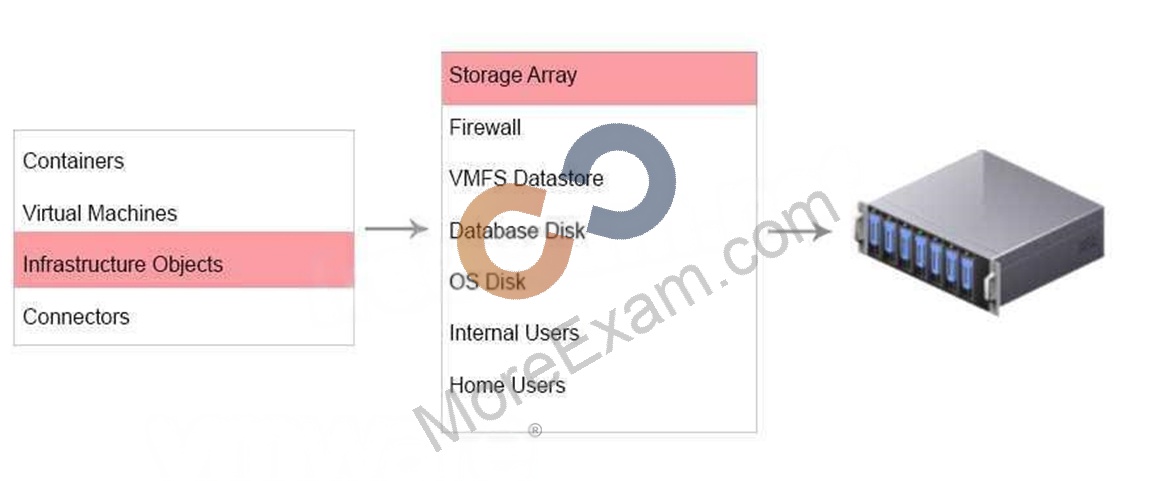
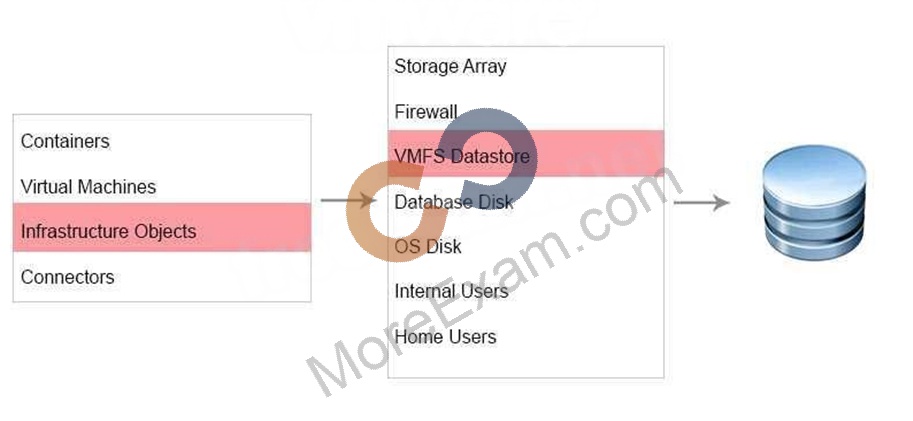
Place all items in required container(s). Connect VMFS datastore(s) to required virtual machine(s). Place disk(s) over the required storage type(s). Connect firewall(s) to container(s).


Question4: Referring to the exhibit, which appliance or device belongs in the square with the question mark?

Question5: An organization is trying to determine whether it should use the Windows version of the vCenter Server or use the vCenter Server Appliance (VCSA). The organization will be using an external Oracle database, and it will manage about 30 ESXi hosts and about 200 virtual machines on 1 vCenter Server, but it would also like to see another group's vCenter Server from the same vSphere client window. Which type of vCenter Server should it use, and why?

Question6: A company is consolidating its IT operations efforts by moving the Finance, IT, and QA departments towards a self-service environment, following SDDC best practices.
- All departments have different priorities and expectations for uptime of the required infrastructure and applications.
- Project stakeholders are still discussing final approvals for the
budget wan the CFO.
- To drive down the operating cost of the environment, only blade
servers will implement this project.
- To ensure business continuity, a colocation provider was chosen to
fail over virtual machines.
- The implementation of the project will follow a public reference
architecture provided by VMware.
What is the assumption in this scenario?

Question7: An organization's security policy requires a design where the ESXi hosts will be manageable only through vCenter Server.
Which two security configurations will help meet this requirement? (Choose two)

Question8: Which of the following is not a basic component of a good design?

Question9: A customer is virtualizing a mission-critical Microsoft SQL database and needs a configuration that provides optimal NUMA performance.
- There are two possible clusters that the database virtual machine
could reside in: Cluster A is vSphere 6.0 and Cluster B is vSphere 6.5.
- All ESXi hosts contain dual Intel Xeon E5-2650 v3 processors (ie: 2
socket, 10 cores per socket) and 256Gb RAM with vNUMA in its default
configuration.
Given this scenario, which three statements are true? (Choose three.)

Question10: A company provides critical financial and statistical data for several major banks.
- The company ensures that the bank's customer data is secure and that
analytics data is available when needed.
- Customers rely on this data before making crucial business and
financial decisions.
- Just a few minutes of downtime can result in loss of revenue and
trust.
- To meet high-availability requirements, the company's IT
infrastructure components must be redundant.
- The company established three data centers across the globe and
interconnected them with high-speed WAN links.
- Due to the rapid growth of its customers and their increasing
demands, the compute, network, and storage were procured and managed by the company's enterprise system administrators group.
What are its two key challenges? (Choose two)

Question11: A solution architect has been tasked with designing a new environment that meets the growing needs of a company, and has obtained this information:
- Each new server will use a single 2-port 10Gb Converged Network Adapter (CNA) for both network and storage access.
- The network team has replaced all network equipment with a 10Gb fabric.
- The new environment will host both web servers and Oracle database servers.
- Resources will not be overcommitUid under regular upon at ions to mitigate performance issues.
- The business needs a tool to understand application failures.
- $lmillion has been budgeted for the data center expansion project.
Based this information, which two statements are requirements for the new design? (Choose two.)

Question12: Drag and Drop Question
Sort the traffic by whether it can be encrypted natively by vSphere.

Question13: A company has historically used Auto Deploy without issue. They are now having issues with the PXE infrastructure.
Which option can a systems architect recommend in the Auto Deploy design for better recoverability?

Question14: A business organization has different types of network traffic, and all the types of traffic must be kept separated. The design architect knows that the number of required networks is greater than the number of physical ports in the system.
Which three choices can the architect use to keep the traffic separated? (Choose three.)

Question15: A customer wants to improve the performance of its vMotion migrations. The current configuration has only one VMkernel port group for vMotion using vmnic3.
The customer has vmnicS available for use.
What change can be made to increase vMotion performance?

Question16: A nonfunctional requirement _____________.

Question17: A company has requested assistance with a new cross-site failover design between two sites which will support business-critical applications.
* Latency between the sites is less than 5ms roundtrip.
* Downtime for the applications could result in millions of dollars in lost revenue.
The company requires:
* Application restart in the event of a total site failure
* Allow for planned migration during maintenance
* Applications must be kept online even when migrated due to planned site maintenance Which two options would meet the company's requirements? (Choose two.)

Question18: Customer Requirements:
You have been tasked with creating a vSphere 6.5 data center design for an organization. The organization has produced two 24 port FC switches, and Asymmetrical Active/Active storage array (2 storage Processors with 4 ports each) and 22 ESXi Hosts with 2 dual port HBAs in each.
Due to budgetary constraints, the organization cannot purchase anymore equipment. They have provided the following requirements:
- The existing Fibre Channel (FC) Asymmetrical Active/Active Array and FC switches must be used.
- No single point of failure to any datastore.
- Configuration must provide failover and load balancing.
- The customer requires a solution that will accommodate virtual machines with three different I/O load requirements:
- Static web virtual machines
- Critical application virtual machines.
- Object storage for their database virtual machines.
Design Requirements:
Create a logical design that be applied to each of the ESXi Hosts. The design should meet, but not exceed the customer's requirements and should include:
- All required hardware
- All required resources
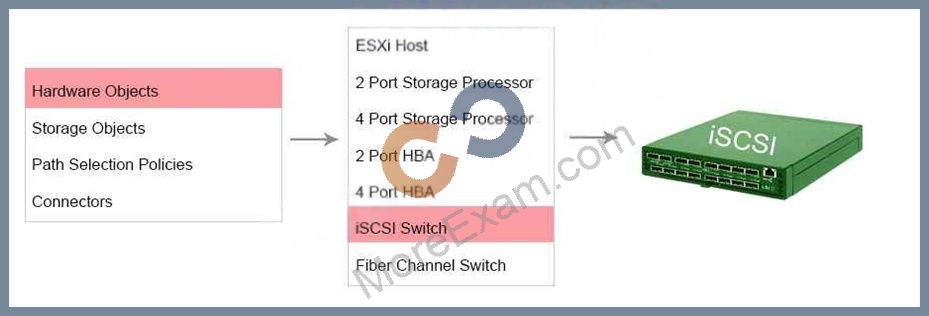
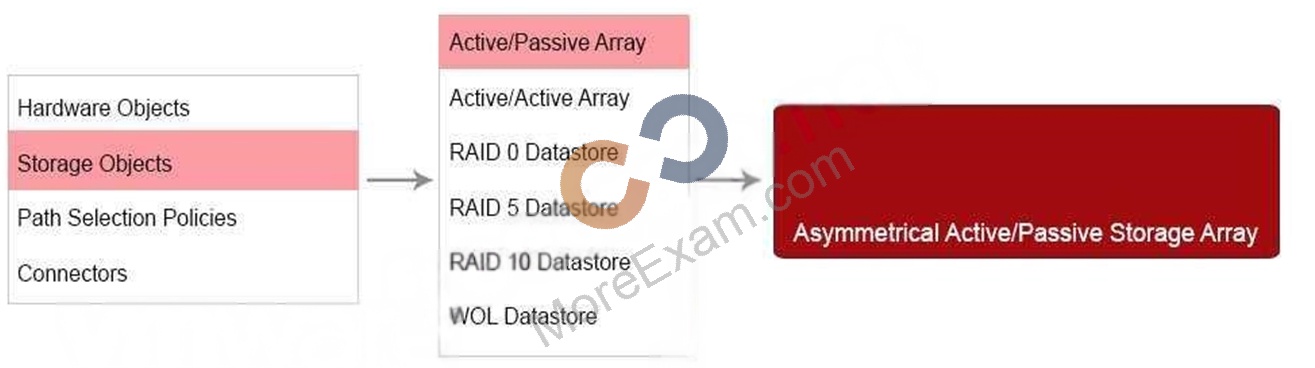
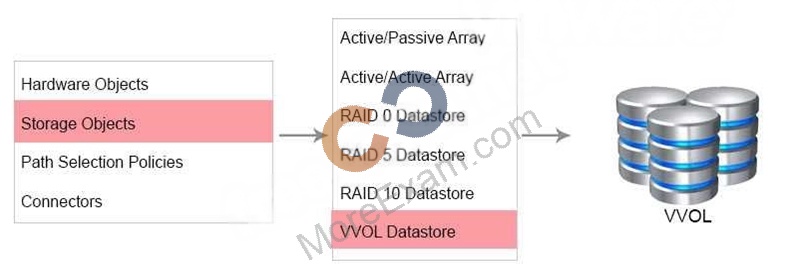
Place the required datastore(s) in the storage array(s). Connect the storage processor(s) to the storage array(s). Connect the switch(es) to the storage processor(s) and HBA(s).
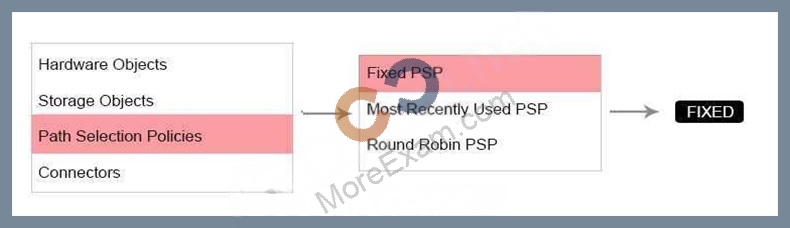
Connect the ESXi host to the HBA(s) and Path Selection Policies.


Question19: A functional requirement ____________.

Question20: A company has a database server that requires intensive random write performance on its traditional iSCSI storage running in RAID LUNs.
- Currently, it is running on a physical server.
- The customer would like to consolidate its existing environment by virtualizing.
When architects a vSphere 6.5 design, which three components would ensure storage performance and availability? (Choose three.)

Question21: Drag and Drop Question
You have been tasked with creating a vSphere 6.5 data center design for an organization. The organization is evaluating various design options and their impact on the design. For each design option, determine the design characteristic that would be affected by utilizing the option. Match each Design Option on the left to the Characteristic on the right by dragging the red button (O1- O5) over the text of the appropriate Characteristic. NOTE: Design Options can be mapped to more than one Characteristic or none at all.

Question22: Drag and Drop Question
A company is a leading provider for an online travel booking system with over a $1,000,000 turnover each day. The company warns to leverage VMware cloud solutions to consolidate, scale, and ensure high availability for all of its data centers.
Match each business requirement to its appropriate design concept.

Question23: Drag and Drop Question
Categorize the tools as providing either Availability or Recoverability.

Question24: DRS/HA cluster services depend on which two resources? (Choose two.)

Question25: A customer warns to virtualize an Oracle database with vSphere 6.5, but is concerned about its performance.
Which three design elements will ensure optimum performance? (Choose three.)

Question26: A customs has requested a vSphere 6.5 deployment design where ESXi hosts are provisioned with Auto Deploy. The customer requires that certificates can be automatically refreshed and renewed from the vSphere Web Client for ESXi hosts.
Which certificate policy should be configured for vCenter Server?

Question27: Drag and Drop Question
You have been provided with a list of requirements for a vSphere Design. For each requirement, categorize the requirement as a component of the WRT, RTO, RPO, MTD, and Recoverbility.
Drag a requirement button (R1-R8) over to the green space provided beside the corrisponding Design Phase.

Question28: Which of the following is not a reason to use virtualization?

Question29: A customer has requested a vSphere 6.5 deployment design that utilizes vCenter Server and the use of vMware-recommended best practices for securing vCenter Server.
Which three actions would satisfy these requirements? (Choose three.)

Question30: Drag and Drop Question
You have been tasked with creating a vSphere 6.5 design for an organization. The organization is looking to implement a Virtual SAN into their environment. You have been tasked with determining whether a given Virtual SAN logical design decision meets the technical requirements of their infrastructure.
For each Design Decision on the left drag the red Decision buttons (D1-D8) on the right and place it on the proper Technical Requirement.
NOTE: Not all Design Decisions will be used.

Question31: Drag and Drop Question
You have been tasked with creating a vSphere 6.5 design for an organization. The organization has a mission critical application that must be able to obtain its required CPU and memory resources even if contention occurs. You must determine which vSphere service(s) will allow for resources to be reserved.
Associate the vSphere Service on the left with the corresponding Reservation Type on the right by dragging the red button (S1-S6) over the text of the Reservation Type. NOTE: A vSphere Service may allow for more than one Reservation Type or none at all.

Question32: Drag and Drop Question
You have been tasked with creating a vSphere 6.5 design for an organization. The customer wants to ensure isolation in the network but does not know when to incorporate physical networks, VLANs and PVLANs.
Evaluate the design requirement and determine the isolation method to satisfy the design. Match each Design Requirement on the left by dragging the red Requirement buttons (R1-R5) over the text of the appropriate Isolation Method.
NOTE: Multiple Design Requirements may fit each Isolation Method.

Question33: Which of the following needs to be considered when determining the amount and size of the hosts required for a virtual design?

Question34: In order to provide a critical service, a customer needs four virtual machines (VMs), each with
55GB memory reservation.
- This service must NOT experience an outage due to host hardware failures or host maintenance.
- The customer has ESXi hosts with 256GB of RAM each and, for business reasons, must run this service in a new ESXi host cluster.
Which VMware-recommended solution meets the stated requirements?

Question35: A company would like to leverage snapshot technology on vSphere 6.5.
Which configuration supports taking snapshots?

Question36: Drag and Drop Question
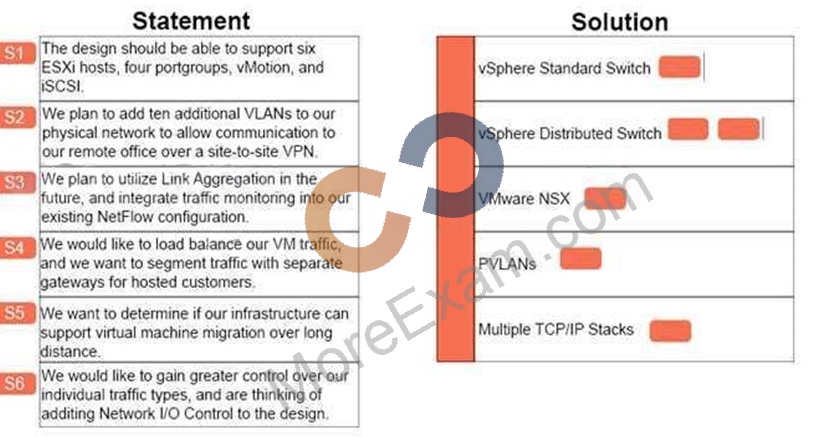
You have been tasked with creating a vSphere 6.5 center design for an organization. The organization is currently evaluating vSphere network technologies that can be utilized with their existing infrastructure. Evaluate each statement provided through requirements gathering and determine the network technologies that can be used to meet that requirement. The technology(s) chosen should be limited to what is needed to meet, but not exceed, the given requirement.
Match Statements on the left by dragging the red buttons (S1-S6) over the text of the appropriate Solution.
NOTE: Statements can match more than one Solution or none at all.

Question37: A solution architect has been tasked with designing a new environment that meets the needs of a growing company, and has obtained this information:
- Uptime is critical during regular business hours when 95% of transactions occur. Application uptime must be 99.9% during those hours.
- In a true disaster, the business can withstand a day of data loss and half a day of downtime.
- The company is one year into a 5-year contact with the co-lo data center.
- The building that is currently occupied no longer has any floor space available, but the company has three empty racks of space.
- There are current contacts with Dell to provide servers and Cisco to provide network components.
- The network team has standardized on an end-to-end 10Gb network.
Based on this information, which two statements are constraints for the new design? (Choose two.)

Question38: Drag and Drop Question
You have been tasked with creating a vSphere 6.5 data center design for an organization. The organization has identified a number of challenges that occur within their current infrastructure that they would like addressed in the design. For each challenge, determine the vSphere technologies that could be used in the design.
Match each Challenge on the left by dragging the red Challenge buttons (C1-C4) over the appropriate Technology.

Question39: A solution architect has been tasked with designing a new environment that meets the needs of a growing company, and has obtained this information:
- The current capacity will be exhausted in 180 days, and the new
infrastructure must be deployed and in production prior to that.
- The new servers have a 90-day delivery time.
- A data center for disaster recovery has been selected, and it is 20
miles away and connected by MPLS.
- The security team will continue to utilize its current investments
and VM Encryption for the new environment.
- The backup team currently uses Data Domain, and reports show an 8:1
compression and deduplication ratio for backups.
Based on the information obtained, which two statements are risks for the new design? (Choose two.)

Question40: An architect is planning a vCenter 6.5 solution that requires the virtual machine to run Windows
2012 R2 as the operating system.
- The solution should provide a single management interface for all of the vCenter Server installs.
- The architect is concerned that the organization's primary Oracle database server is NOT available at all of the sites where a vCenter Server will be installed and will NOT be included as an option in the design.
Which two database solutions are valid options in the design document? (Choose two.)

Question41: You are a platform designer constructing a physical design from an existing approved logical design. Out of the vendor proposals, there are two proposed solutions that could be used. Which of the following options is the most important factor when making a decision?

Question42: A company is consolidating its environment into vSphere 6.5, and uses a Fibre Channel SAN array to host a virtual machines.
- It has a pair of MSCS clustered VMs with shared RDM.
- High availability of service is its top priority.
- It wants to ensure that performance is optimized for the cluster service.
The design requirements are:
- Storage should be able to withstand at least one component failure.
- Each server has at least 2 ports for FC connections.
- MSCS should also have no single point of failure with the clustering service.
Which design will meet these requirements?

Question43: A company has requested that a new vSphere 6.5 design be created.
- The existing environment consists of 32 vSphere 6.0 hosts attached to an iSCSI storage array.
- The storage arrays contain external customer financial and medical
records used by the company's investment and medical services division.
The design must:
- protect the company's existing data center investment
- expand to a second data center site
- introduce process automation
- expand to and fail over to public cloud
Which two non-functional requirements are applicable for this design? (Choose two.)

Question44: A university is going through an IT transformation project and is re-evaluating how to use technology to provide a better academic experience for its 15,000 students. The university is a current VMware customer and has a single data center.
- Within that data center, the university is using blade servers backed by a Fibre Channel array for its business critical applications
- It has two iSCSI arrays (one for the development environment and other for the no-critical production environment)
- The university's VMware environment consists of three clusters. The first cluster contains all development virtual machines (VMs), the second cluster is dedicated to DMZ VMs, and the final cluster contains production VMs
- The university requires the ability to perform hardware maintenance without a service interruption, and can only sustain 4 minutes of downtime per month From the list below, which three are constraints? (Choose three.)

Question45: A developer is tasked with building an application to process shipping requests. The developer is consulting the vSphere team to determine failover options and performance best practices.
- The development team is providing three physical ESXi hosts with 8
CPU cores and 256G8 of RAM per host.
- The developer does NOT know how many virtual machines they will
require.
Which virtual machine (VM) sizing strategy will provide the highest level of uptime, individual VM performance, and failover capacity?

Question46: A solution architect has finished conducting interviews and gathering requirements for a company, and has determined that the logical requirements are:
- two data centers for high availability
- synchronous replication to meet the zero minute RPO
- separating management workloads from application workloads
- dedicated 10Gb uplink for each low latency server
- single management point for the entire environment
Which two actions would meet the design requirements? (Choose two.)

Question47: Two DCs with 10mb circuit:
- This comprise of vSphere replication and srm in place for DR and recovery
- it can tolerate up to 1 hour of data loss
- the data change rate is about 10Gb/hour
What would be the logical concept? (Choose Two)

Question48: Customer Information
The Customer Labtown has a new vSphere 5 environment with one of their line of business applications recently being virtulized. Labtown requires that their Webserver, Database Server, and Fileserver for their line of business app be created into a vAPP. The VM's should start up in a specific order to insure the application starts correctly after an outage or reboot. Labtown also wants the best performance possible out of each VM. There is three hosts in the cluster each running the same CPU and Memory specifications. each host is running at 60% utilization right now. Labtown doesn't have any budget for more hosts.
Create a logical vAPP design for Labtowns Line of Business Application Requirements
- The server must boot in the following order: DB, Fileserver, WebServer
- Each VM must perform the best it can with the current cluster configuration Instructions
- Place the three VM's on the vAPP
- Place the boot order boxes ontop of each VM to indicate the VM's boot order
- Place the VM stencil for each VM in the DRS rules section if you wish to apply DRS rules to the design
- As long as VM's are on the vAPP stencil marks will be scored

Question49: Which component of a good design is described as the quantitative statement of what the project does and does not include?

Question50: The hardware operations team is planning to purchase new ESXi hosts for the upcoming budget year and is requesting recommendations on the type of servers to purchase for a web application.
The web application consists of hundreds of small virtual machines (1 vCPU and 8GB of RAM) that are members of a software cluster.
The solution should have these abilities:
- recover from ESXi host hardware failures
- zero downtime for a limited number of critical virtual machines (VMs)
- migrate running VMs between ESXi hosts without interruption to the
operating system
- perform these functions using VMware ESXi servers, vCenter Server,
and high-speed network interfaces
What are the three functional requirements and their associated VMware technologies? (Choose three.)

Question51: A company has a vSphere 6.5 environment with vSAN 6.5 and iSCSl storage.
- In the vSphere cluster, HA and DRS are enabled.
- The servers have multiple NIC ports and not all of them are in use.
- The customer wants to put additional unused NIC ports on the heartbeat network to ensure higher availability.
Where should the unused NIC be placed?

Question52: A company has asked a systems architect to include an existing. Which design concept applies to this situation?